
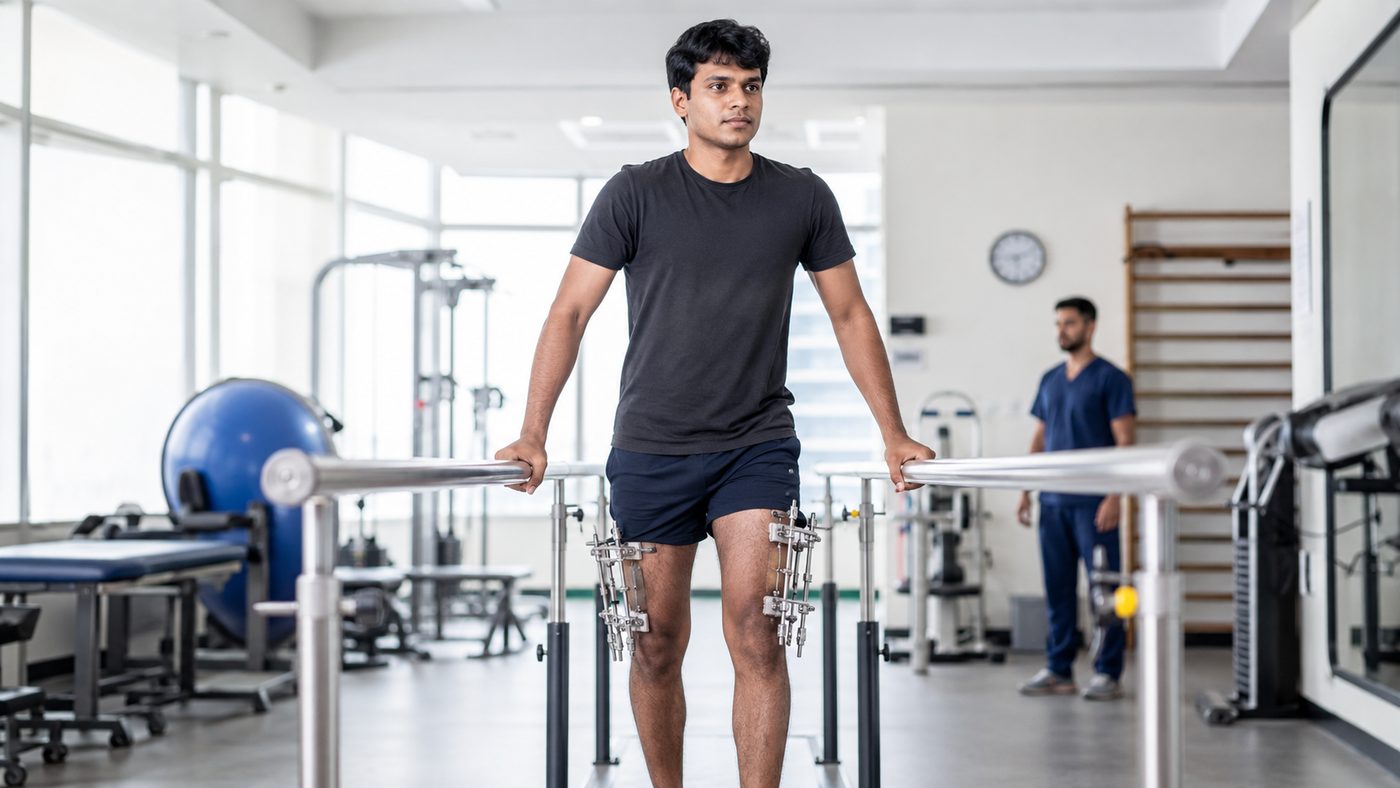
Four months ago, a young man measured 165 cm and decided enough was enough. He watched videos on limb lengthening for a full year before he booked his femur lengthening surgery.
The decision itself was not slow. He knew he wanted it done. He just needed the right window to actually go through with it.
He chose a 4.2 cm gain on his femur, a number that sounds specific until you hear his reasoning. He did not want extreme proportions. The original plan was to add 4 cm to the femur and 3.5 cm to the tibia, making a total of 7.5 cm, partly because his wingspan set a ceiling on how far he could safely push things.
Right now, he stands at 169.2 cm, and the bone development is complete.
The First Days With the Frame
Fear did not show up until the car ride to the hospital. Before that, he says, he was not really scared. Once the external fixator was on, the early days brought real discomfort, more than he expected going in.
That eased gradually. By the 15 to 20 day mark, he had reached about 2 cm of lengthening and stopped needing pain medication altogether.
He even started telling people nothing was bothering him anymore, which turned out to be a little premature. Once the lengthening rate moved up to 1.25 mm, the pain came back within a few days. The team scaled it back down after that.
It is a pattern many femur lengthening surgery patients run into: the bone responds well early, the rate is increased, and the body pushes back. He had already shown good callus formation by that point, which is partly why the increase was tried in the first place.
Femur Versus Tibia, in His Own Words
He has also seen tibia patients up close, including someone close to him who went through it. His comparison is blunt. In his experience, tibia lengthening was not as hard as femur lengthening.
If someone is only doing one segment, his advice leans toward the tibia, mainly because many patients choose the femur and end up gaining seven to eight centimeters there, sometimes more than the six centimeters typical of the tibia.
He has watched friends complete smooth 7.5 cm tibia lengthenings too, while others still deal with bending issues on that bone.
His take on avoiding complications comes down to consistency. Morning and evening physiotherapy, without skipping sessions, matters more than people give it credit for. He has noticed many patients treat physiotherapy as optional, and that is where problems start creeping in.
Daily Life on the Frame
Routine things such as getting dressed, doing wound care, and getting to the bathroom were hard to figure out at first. He built a structure for himself early on, and once that clicked, daily life stopped feeling overwhelming.
It was not effortless, but it became manageable, which is different from easy.
Physically, he has gained about two inches so far. It does not feel dramatic to him, but it is noticeably taller. He expects the people closest to him, including friends and family, may notice it even more when he returns home.
Why He Picked This Center
Experience was the deciding factor for him. He felt the team had handled more cases than most others offering leg lengthening in India, and that tipped his decision.
Looking back after four months, he has no doubts about the choice.
His advice to anyone considering leg lengthening in India is practical: come in with realistic expectations. Do not chase 10 centimeters on a single segment, because that number does not hold up against how bones and bodies actually respond.
Having a roommate during the process helped more than he expected. The low points hit harder when you are alone with your thoughts and a frame on your leg, and having someone around to talk to helped him get through those moments.
Where Recovery Stands Now
Recovery is not finished yet. He expects another two weeks to a month before things feel fully settled, even with bone formation moving faster than average.
For now, everything is on track. The four months were not easy, but they were structured, monitored, and manageable with consistent physiotherapy and realistic expectations.