
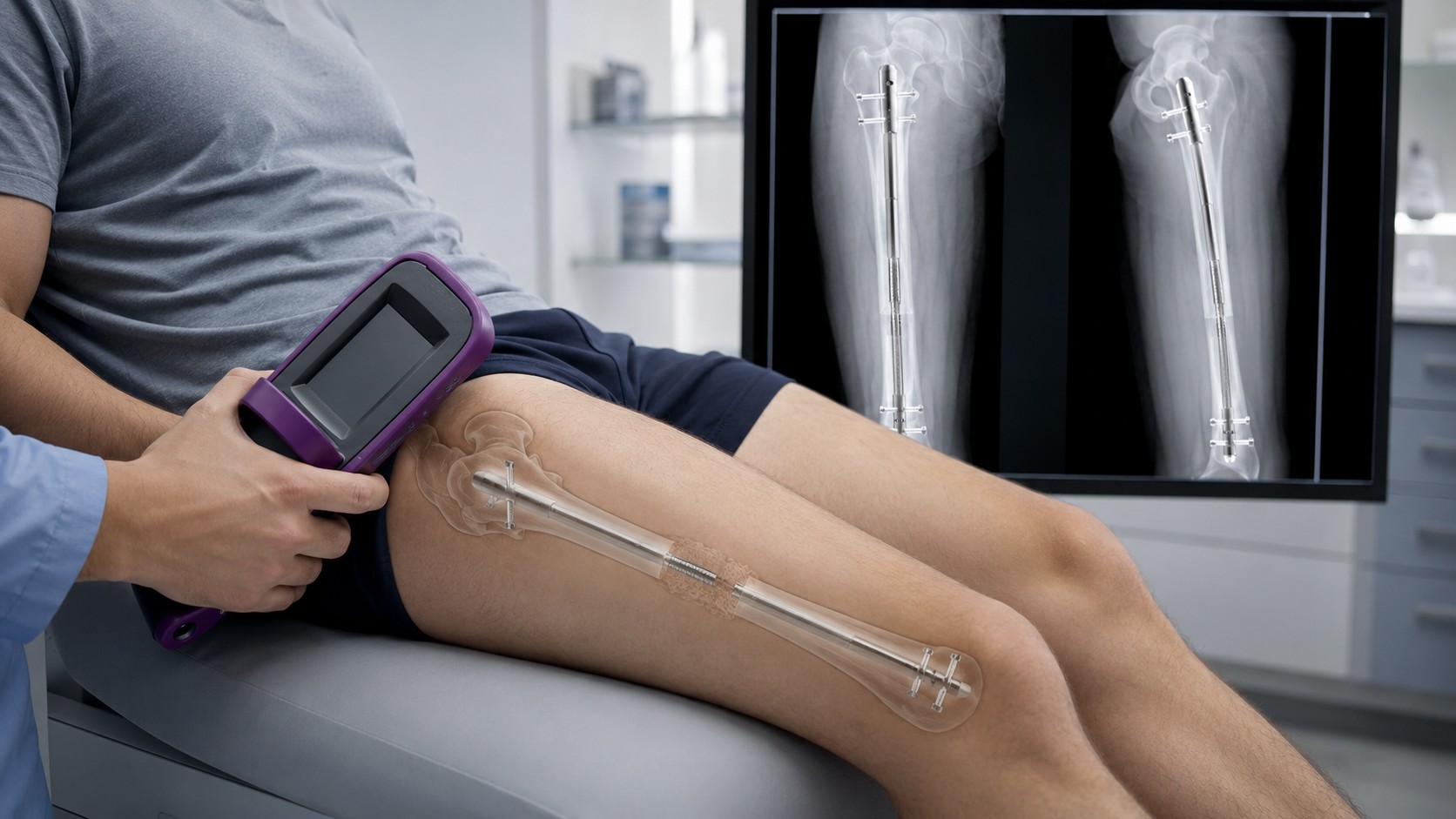
There is a moment in every PRECICE lengthening cycle that looks completely uneventful from the outside. A patient sits with a small remote control pressed against the thigh. Nothing visibly moves. There is no sound from the leg itself.
But inside the bone, a gear is turning, a rod is extending by a fraction of a millimeter, and the surrounding bone is being asked to grow into the gap that just opened.
Most explanations of limb lengthening skip past this part and jump straight to outcomes. To understand how the PRECICE nail works, it helps to slow down and look at what happens inside the bone, not only what the patient sees from the outside.
The Nail Is Not a Static Rod
A PRECICE nail can look deceptively simple from the outside, like a long metal rod that a surgeon slides into the marrow canal. Internally, it is closer to a small mechanical instrument.
The device is telescoping. It is built from two pieces that nest inside each other and can extend apart through a spindle and gearbox. At the center of that gearbox is a permanent rare-earth magnet.
That magnet is the reason the nail can lengthen without wires, batteries, or motors crossing the skin.
How the Magnetic Mechanism Works
This is the core of how the PRECICE nail works. The magnet inside the nail does not power itself. It responds to a magnetic field generated outside the body by an external remote controller.
Inside that remote are rotating magnets. When the patient turns the device on, those magnets spin. Their magnetic field passes through skin, muscle, and bone to interact with the internal magnet in the nail's gearbox.
The internal magnet rotates in response. That rotation drives the gear. The gear turns a screw. The screw pushes the two telescoping halves of the nail apart, just a fraction of a millimeter at a time.
Getting the Nail Into Position
The mechanism only works if the nail is positioned correctly. That is why surgical planning is as important as the device itself.
Before surgery, imaging helps the surgeon trace the canal through the center of the bone, decide the required nail length and diameter, and choose where the bone will be cut.
The outside of the bone is dense. The inside, where the nail sits, contains softer marrow tissue. A drill is used to widen the canal enough for the nail to pass through cleanly.
In femur lengthening, the nail may be inserted from the hip side, called antegrade insertion, or from the knee side, called retrograde insertion. The choice depends on anatomy, bone shape, and any existing deformity.
Once the nail is seated and the bone is cut, the two bone segments are held around the nail. Lengthening usually begins later, after the early healing response has started.
Daily Activation and Distraction Osteogenesis
Once activation starts, the process is slow and deliberate. Many protocols use around 0.75 to 1 millimeter of lengthening per day, often divided into several smaller activations rather than one large adjustment.
That pace is not random. Bone tissue can only create new material at a certain speed. If the gap opens too quickly, new bone may form too slowly or too thinly. If the process is too slow, nearby soft tissue can stiffen instead of stretching well.
This controlled gap formation triggers internal distraction osteogenesis. The body senses gradual separation and tension at the cut site and responds by laying down new soft bone tissue to fill the space.
Over the following weeks, that soft bone mineralizes and hardens into mature bone. This continues during the consolidation phase, even after the nail has stopped extending.
Why Precision Matters
A PRECICE intramedullary lengthening nail is valued because it allows fine control over rate and direction. The magnetic system can provide sub-millimeter adjustments during lengthening.
Because the external controller can reverse the magnetic rotation, the nail can also retract slightly if needed. That gives the surgeon a way to correct overcorrection without another operation in selected cases.
This precision is one reason internal nails have replaced external fixator frames for many suitable patients.
Why Internal Nails Changed Limb Lengthening
External frames worn outside the leg came with pin sites that needed daily cleaning and carried a real infection risk. They also placed visible hardware around the limb and could limit motion at nearby joints.
A fully internal nail avoids many of those problems because nothing crosses the skin during daily lengthening. The remote is only held against the thigh during short activation sessions.
What Patients Actually Notice
The mechanical activity inside the bone does not always match what patients feel. The external remote controller may make a buzzing sound while running, but most patients do not feel the gear turning directly.
What they may notice is a dull stretching sensation in the thigh or calf as soft tissue is pulled along with the lengthening bone. This tends to build gradually across activation cycles.
Not Every Patient Is a Candidate
Understanding how the PRECICE nail works also means understanding where it may not apply. A history of bone infection in the treated limb can rule it out because the healing response may not be reliable enough.
A marrow canal that is too narrow or badly offset can also make the device unsuitable. Patients with certain programmable medical implants, such as pacemakers or neurostimulators, need careful evaluation because the magnetic field may interfere with those devices.
These decisions are made by the surgeon and patient after reviewing anatomy, medical history, goals, and risk.
The Bigger Picture
Strip away the branding and the PRECICE nail is an elegant piece of engineering: a magnet communicating with another magnet through living tissue, turning a gear, and asking bone to grow into a gap that opens millimeter by millimeter.
Understanding how the PRECICE nail works does not make the surgery less significant, but it does explain why this approach has reshaped modern limb lengthening. The mechanism is mechanical on paper. What it produces, new living bone where there was not any before, is anything but ordinary.