
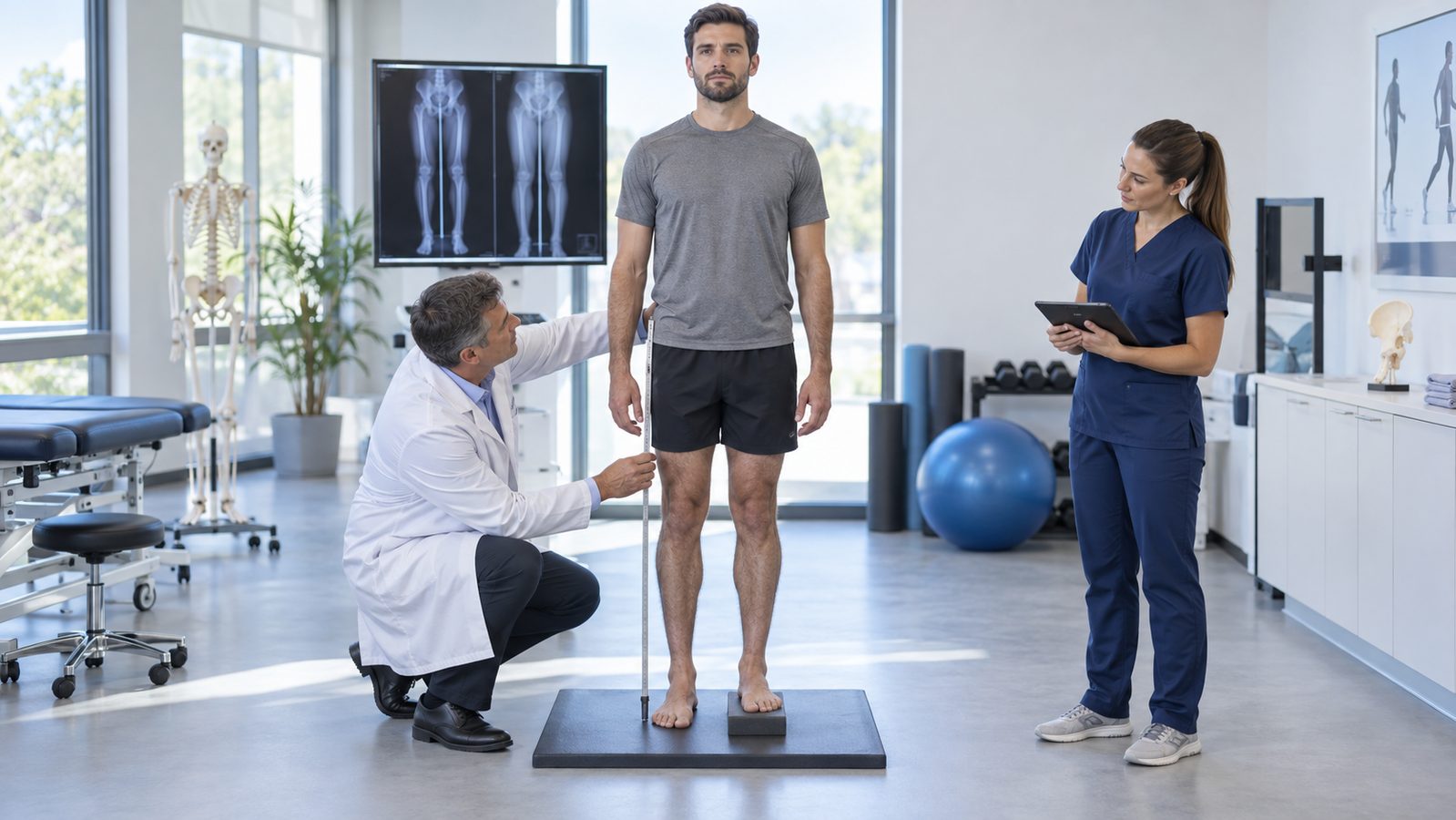
Not every patient considering limb lengthening wants to increase height equally on both sides. Some patients have one leg that is already shorter because of a congenital condition, childhood growth-plate injury, infection, fracture, neurological condition, or previous surgery. Their goal is usually better symmetry, gait, balance, and function.
Leg length discrepancy treatment is therefore different from cosmetic bilateral lengthening. The cause, expected progression, bone alignment, joint stability, muscle balance, and age of the patient all influence the plan.
The Cause of the Discrepancy Matters
A true structural discrepancy can arise from congenital conditions such as fibular hemimelia or femoral deficiency. Acquired causes include growth-plate damage, bone infection, trauma, tumors, neuromuscular conditions, and the effects of earlier surgery.
Congenital cases may involve more than length alone. Joint instability, missing or underdeveloped structures, angular deformity, rotation, and foot differences can all affect treatment. A specialist evaluation should identify the entire problem before deciding whether equalization, deformity correction, or both are appropriate.
How Severity Influences the Treatment Discussion
Not every difference requires surgery. Measurements must be interpreted together with symptoms, gait, skeletal maturity, future growth, and the patient's goals. The ranges below are common discussion points rather than automatic treatment rules.
| Measured or projected difference | Options commonly considered |
|---|---|
| Up to about 2 cm | Observation, an in-shoe lift, footwear modification, and symptom-based care are often considered. |
| About 2-5 cm | Shoe lift, growth modulation in selected growing children, shortening, or lengthening may be discussed depending on the case. |
| More than about 5 cm | Lengthening, staged reconstruction, or combined procedures may be considered, especially when deformity is also present. |
These ranges are general educational guidance. A treatment recommendation requires clinical examination, calibrated imaging, and an individualized risk-benefit discussion.
Growing Children Require a Different Calculation
In children, the present difference is only part of the picture. A discrepancy can increase as the child grows, so surgeons use repeated examinations, standing imaging, skeletal age, and growth-prediction methods to estimate the difference expected at maturity.
The plan may be staged. One part of the correction may be performed earlier, while another is timed closer to skeletal maturity. This is especially relevant when the underlying condition continues to affect growth.
When Epiphysiodesis May Be Considered
Epiphysiodesis is a growth-modulation procedure used in selected children who still have meaningful growth remaining. It slows or stops growth at a growth plate in the longer leg, allowing the shorter side to reduce the difference over time.
Timing is critical because the procedure is based on the predicted discrepancy at maturity, not only the measurement on the day of consultation. It is not an option for adults after skeletal maturity and is not suitable for every pediatric discrepancy.
When Lengthening Becomes the Preferred Option
Limb lengthening may be considered for larger discrepancies, for adults who have completed growth, or when growth modulation cannot provide enough correction. The shorter bone is divided in a controlled procedure and gradually separated so new bone forms in the gap through distraction osteogenesis.
Depending on bone size, anatomy, age, deformity, and clinical goals, the surgeon may consider an external frame or an internal lengthening device. Some skeletally mature patients may instead discuss shortening the longer leg when the anticipated correction is more moderate.
Deformity May Need Correction at the Same Time
A leg length difference can occur alongside bowing, rotational malalignment, joint contracture, or an abnormal mechanical axis. Simply making the bones equal in length may not restore efficient movement if those problems remain.
Complex cases may require a combined limb reconstruction and deformity correction plan. Certain external fixation systems can gradually adjust length, alignment, and rotation, while other cases may use staged procedures.
A Full Limb Equalization Plan
A comprehensive limb length equalization procedure may combine bone lengthening, angular or rotational correction, management of joint contractures, and an extended physiotherapy program. The plan should also account for the patient's home environment, mobility aids, school or work, travel, and the expected follow-up schedule.
This is why these cases benefit from a team experienced in both lengthening and deformity correction. Patients can review the clinical team led by Dr. Hirdesh Kumar before arranging an assessment.
Muscle Balance and Gait Need Attention Too
Years of walking with unequal leg lengths can produce a tilted pelvis, altered hip and knee mechanics, and deeply learned compensatory movement patterns. Correcting bone length does not automatically erase those habits.
Structured rehabilitation after limb lengthening should address joint range, muscle flexibility, strength, balance, and gait retraining. Progress is monitored alongside radiographs so activity and weight bearing can be advanced safely.
What Patients Should Expect
Outcomes can be strong when the diagnosis is accurate and associated deformity is addressed, but congenital and long-standing discrepancies often require more planning than straightforward cosmetic lengthening. Recovery may involve months of follow-up, physiotherapy, imaging, and gradual functional retraining.
The goal is not simply matching two measurements. It is to improve alignment, gait, comfort, and practical function while keeping the risks and demands of treatment proportionate to the benefit expected.
Frequently Asked Questions
Can limb lengthening correct a pre-existing leg length discrepancy?
Yes, selected structural discrepancies can be treated by lengthening the shorter limb. The decision depends on the cause, size of the difference, skeletal maturity, alignment, joint health, and the patient's functional needs.
Does every leg length difference need surgery?
No. Small or well-tolerated differences may be observed or managed with a shoe lift. Surgery is considered only after an individualized assessment of symptoms, projected progression, and treatment tradeoffs.
Why is treatment different for children?
Children still have open growth plates, so the expected discrepancy at skeletal maturity must be estimated. Growth modulation may be an option when timing and the projected difference are suitable.
The Bottom Line
Leg length discrepancy is not a single problem with a single solution. Treatment can range from observation and shoe lifts to growth modulation, shortening, limb lengthening, or combined deformity correction. The right plan starts with understanding the cause and measuring the complete mechanical problem.
To discuss your discrepancy, imaging, gait, and possible treatment options, schedule a consultation with Height Increase Info.