
Six months after limb lengthening, an X-ray can look excellent. The regenerate bone may appear consolidated, the alignment may be clean, and the gap may look fully bridged. Yet the patient may still limp on stairs, hesitate to run, or feel that the operated leg is not completely trustworthy.
That mismatch is one of the most important parts of recovery. Bone healing and physical recovery do not always follow the same timeline. A radiograph shows whether the new bone can tolerate load, but it does not show whether the surrounding muscles, tendons, joints, and gait pattern have recovered well enough for daily life.
Why X-Rays Tell Only Part of the Story
In distraction osteogenesis, new bone forms in the space created after the corticotomy. Imaging is essential for checking regenerate density, alignment, consolidation, and implant position. None of that should be ignored.
But the rest of the limb is adapting at the same time. Muscles around the lengthened segment are stretched for weeks or months. Tendons and nerves may adapt more slowly. A bone can look healed on film while the leg around it is still weak, stiff, or hesitant.
This is why outcome measures in limb lengthening surgery need to include the whole limb as a working system, not just a single scan.
Weight Bearing Progression Shows Real Confidence
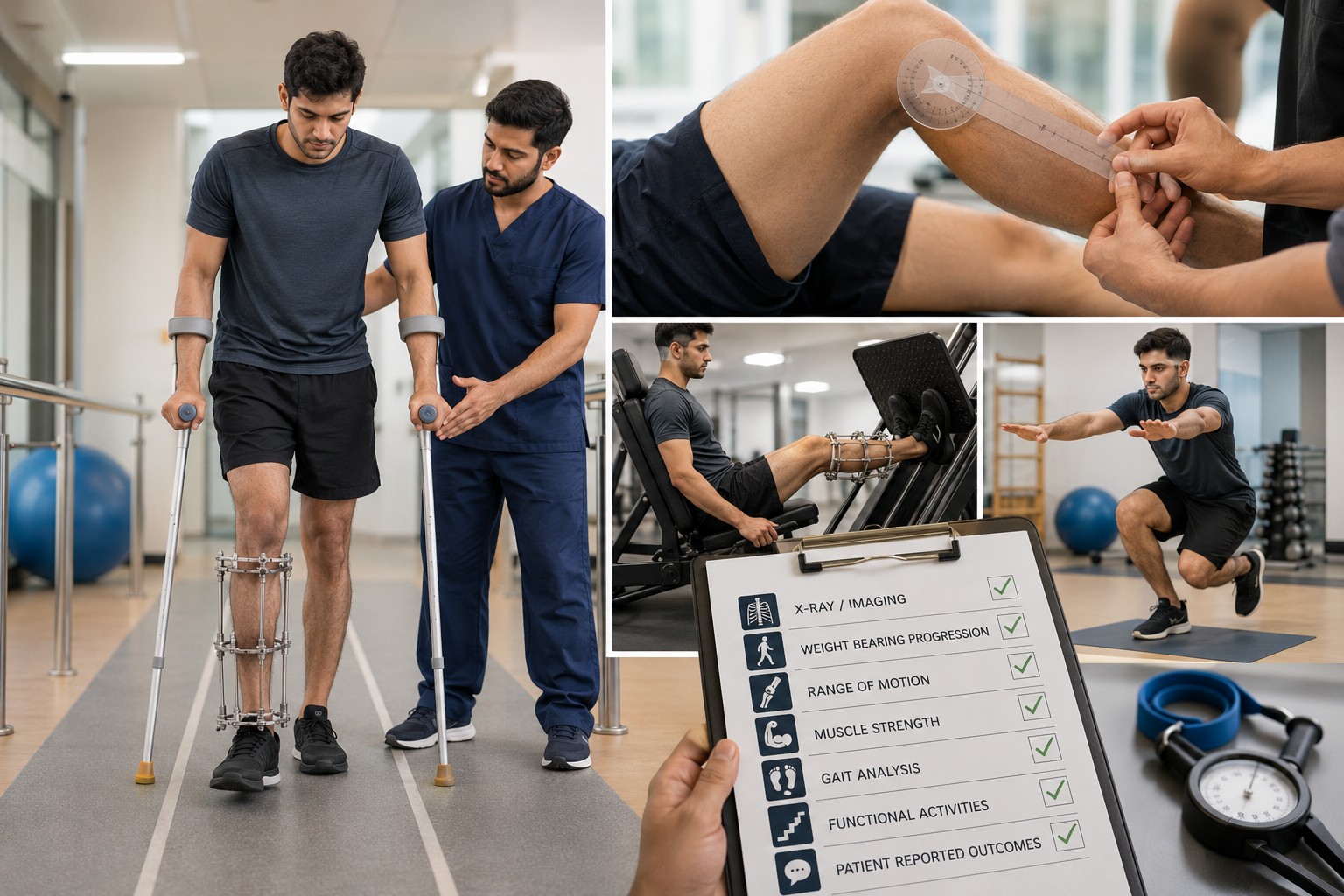
One clear sign of recovery is how a patient moves from partial loading with crutches to walking without support. This is not just a discharge milestone. It shows how much strength has returned, how much pain is still present, and how much the nervous system trusts the operated leg again.
Moving too quickly can leave a limp that outlasts bone healing. Moving too slowly can allow fear and stiffness to take over. A physical therapist can learn a great deal by watching how naturally a patient shifts weight and whether the steps stay even over time.
Functional Outcomes After Limb Lengthening
Functional outcomes after limb lengthening are practical. Can the patient climb stairs without the hip compensating? Can they squat and stand evenly? Can they walk longer distances without the gait breaking down? Can they return to jogging, work, or sport safely?
These details matter because they are daily life. A patient can meet every radiographic milestone and still struggle with sitting cross-legged, getting in and out of a car, standing through a long shift, or carrying weight upstairs.
Range of Motion Needs Its Own Tracking
Knee and ankle range of motion can lag behind bone healing, especially after femur lengthening where the quadriceps may become tight. A knee that cannot bend normally remains a real limitation even when the femur looks excellent on imaging.
Physical therapists often track range of motion with a goniometer at regular intervals. Those numbers matter. A smaller lengthening with poor knee flexion may function worse than a larger lengthening where the patient regained motion early and consistently.
Strength Testing Fills Another Gap
Muscle strength does not automatically return when the frame is removed or the bone consolidates. The operated leg may spend months compensating, and the surrounding muscles may remain weaker than the opposite side.
Some clinics use handheld dynamometers or resistance testing to compare both legs. Others use functional tests such as single-leg squats, step-downs, or controlled balance drills. These tests reveal weakness, hip shifting, wobbling, or movement avoidance that an X-ray cannot show.
Why Clinics Need Broader Outcome Measures
Strong follow-up protocols include gait analysis, range of motion checks, strength testing, weight bearing progression, and patient-reported measures about pain, confidence, and daily function.
Two patients can have almost identical X-rays at twelve months and very different quality of life. One may be back to a regular gym routine while the other still avoids stairs or sport because the leg does not feel reliable.
Without asking about function directly, that difference remains invisible. A protocol that only checks bone density can miss patients who are technically healed but functionally behind.
Putting It Together
If you are going through limb lengthening, do not let the X-ray be the only measure of progress. Ask how strength is being tracked. Ask how range of motion is checked. Ask what the team expects for walking, stairs, balance, and return to activity at each stage.
The scan can tell you when the bone is solid. It cannot tell you whether you trust the leg on an uneven sidewalk or whether you can carry groceries upstairs without thinking about every step. That part of recovery is measured in movement, not millimeters on a screen.