
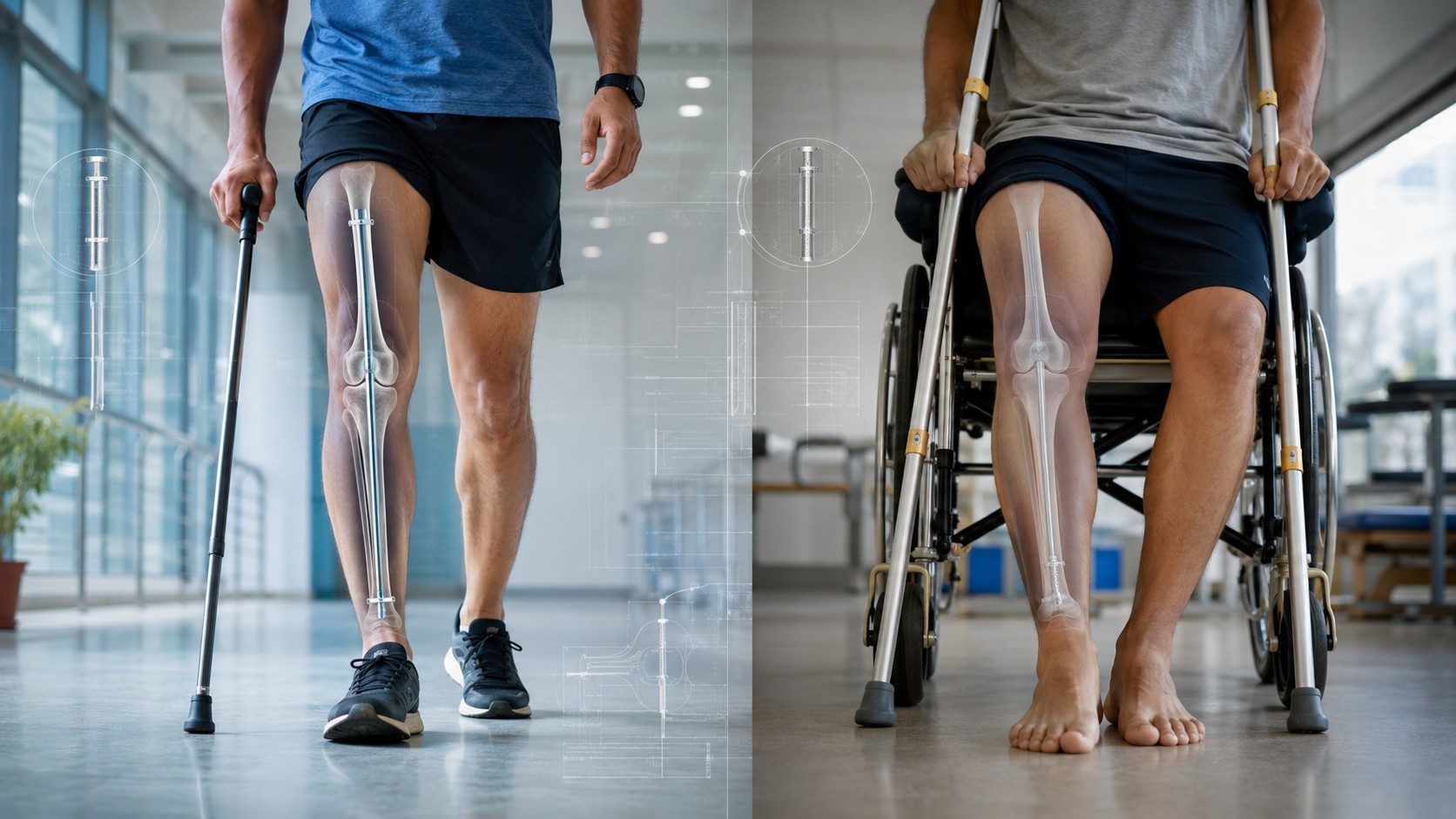
Limb lengthening has changed significantly over the years. In the past, many patients walked with bulky external frames strapped to the outside of their legs for months. These frames could be uncomfortable and carried a higher risk of pin-site infection.
Today, many surgeons use internal lengthening nails made of metal and placed inside the bone. When deciding between weight-bearing and non-weight-bearing limb lengthening implants, the engineering of that metal matters. It influences how you walk, heal, and move through recovery.
Understanding the Core Concepts of Limb Lengthening Surgery
Limb lengthening begins with a controlled bone cut. An implant then slowly pulls the two bone ends apart, usually around one millimeter per day. As the gap opens, the body fills it with new bone tissue. This process is called distraction osteogenesis.
Internal lengthening devices, also called intramedullary nails, sit inside the canal of the bone. They hold the bone steady while it grows. The choice between a weight-bearing implant and a non-weight-bearing implant can change daily life for several months.
Weight-bearing implants allow controlled loading of the leg while lengthening is in progress. A weight-bearing nail limb lengthening procedure can help patients maintain mobility. Non-weight-bearing implants usually require crutches, a walker, or a wheelchair until the bone is ready for load.
Engineering Design of Weight-Bearing Implants
Weight-bearing implants must handle the force of the body with every step. The load passes through both the bone and the nail. If the metal cannot tolerate that force, the system can fail.
Material Strength and Geometry
These implants often use titanium alloys because titanium is strong, light, and biocompatible. Engineers focus on the cross-sectional geometry of the nail. A thicker nail wall usually provides more rigidity.
Locking mechanisms at the top and bottom of the nail are also critical. Locking screws attach the nail to the bone and help transfer force through the metal and bone instead of leaving soft tissues to absorb stress.
Mechanisms of Controlled Lengthening
The device must lengthen while supporting body weight. Many internal nails use a magnetic motor or a ratcheting gear system. A remote-control device is placed over the leg to activate lengthening.
Because the patient may be walking on the nail, the internal mechanism must be protected. Gears and motors are sealed to reduce the chance of fluid entering the system. If the motor fails, the lengthening process can stop, so the seal is a major engineering feature.
Clinical Use
Surgeons may choose weight-bearing implants for patients who need significant height or leg lengthening and want to remain more mobile during recovery. However, bone quality must be strong enough. If the bone is weak, even a strong implant may not be appropriate.
Engineering Design of Non-Weight-Bearing Implants
Non-weight-bearing implants serve a different purpose. They are often used when putting pressure on the limb would be unsafe, such as in some pediatric cases, fragile bone conditions, or complex correction cases.
Design for Controlled Stress
Since the patient is not expected to walk on the limb, the implant does not need to withstand the same high axial loads from body weight. Engineers may use thinner profiles, which can fit smaller bone canals.
The goal is stability. Without walking forces, the risk of bending from external pressure is lower, and the implant's main role becomes holding alignment while new bone forms.
Fixation and Stability
Fixation strategies focus on keeping the bone ends in the correct position. Locking screws may be thinner or positioned differently compared with weight-bearing nails. The main goal is to prevent rotation or shifting.
Without the downward force of walking, the nail's job is alignment. The bone ends stay in position, and new growth follows the planned path.
Clinical Scenarios
Doctors recommend non-weight-bearing implants when early mobility is risky. If a patient walks on a nail that was not built for load, the bone can heal crooked or the implant can fail. In these cases, staying off the leg is part of protecting the correction.
The Surgical and Rehabilitation Divide
The choice of implant changes both surgery and recovery. These differences go beyond the metal itself and affect rehabilitation planning, mobility, and daily independence.
Surgical Approaches
Placing a weight-bearing nail requires precise positioning. The bone canal must be wide enough for a thicker nail, and the locking screws must be seated carefully.
Non-weight-bearing implants may allow slightly different surgical paths. Because these nails can be thinner, they may fit into smaller bone canals with less drilling in selected cases.
Weight-Bearing Protocols
The walking timeline is closely tied to implant type. With a weight-bearing nail, some patients may begin putting limited weight on the leg within days, then progress with a walker or crutches as advised.
With a non-weight-bearing nail, the patient must stay off the leg until the bone has consolidated enough for safe loading. This can take months.
Rehabilitation Strategies
Physiotherapy looks different for each path.
- Weight-bearing patients: Therapy focuses on strengthening muscles, restoring balance, and returning to a normal gait.
- Non-weight-bearing patients: Therapy focuses on joint mobility, circulation, and preventing stiffness while avoiding load on the lengthened limb.
Complications also differ. Push too hard on a weight-bearing implant and the metal can fatigue over time. Stay too still during a non-weight-bearing protocol and joints may stiffen while muscles weaken.
Case Studies and Real-World Applications
Example 1: Adult Stature Increase
Consider an adult patient seeking height increase. The surgeon chooses a heavy-duty internal nail and follows a weight-bearing nail limb lengthening protocol. The patient begins physical therapy early and gradually returns to walking, working, and daily life.
In this type of case, the engineering of the nail helps support load during the process while the bone continues to form.
Example 2: Pediatric Leg Length Correction
A child with a leg length difference from a previous injury may need a smaller, non-weight-bearing implant. The child may use a wheelchair and crutches during lengthening while the implant keeps the bone aligned.
Joint mobility remains a priority. Once consolidation is complete, the nail can be removed and the child can return gradually to normal activity.
The Future of Limb Lengthening Implants
Technology in this field is moving quickly. Engineers are improving how these nails work and how they interact with the body.
Advanced Materials
New alloys may become stronger and lighter than current options. Some coatings are being studied to support bone growth or reduce infection risk. Faster healing could mean less time with the implant inside the leg.
Smart Implants
Smart nails may eventually include sensors that send information to the surgical team. Load data, gap measurements, and consolidation status could help doctors adjust recovery plans based on what is happening inside the bone.
Better Patient Fit
Digital models can help surgeons test different implant configurations before surgery. This may reduce guesswork and help match the implant to a patient's anatomy and goals.
Conclusion
Weight-bearing and non-weight-bearing implants differ in design, strength, surgical planning, and recovery expectations. Weight-bearing implants can offer more mobility when the bone and patient profile are suitable.
Non-weight-bearing implants remain important for fragile bones, smaller canals, pediatric correction, or cases where direct pressure could be unsafe.
Before choosing an implant type, discuss your goals, bone quality, daily routine, and recovery expectations with your surgeon. Understanding the engineering behind the metal can make the treatment journey easier to understand and prepare for.