
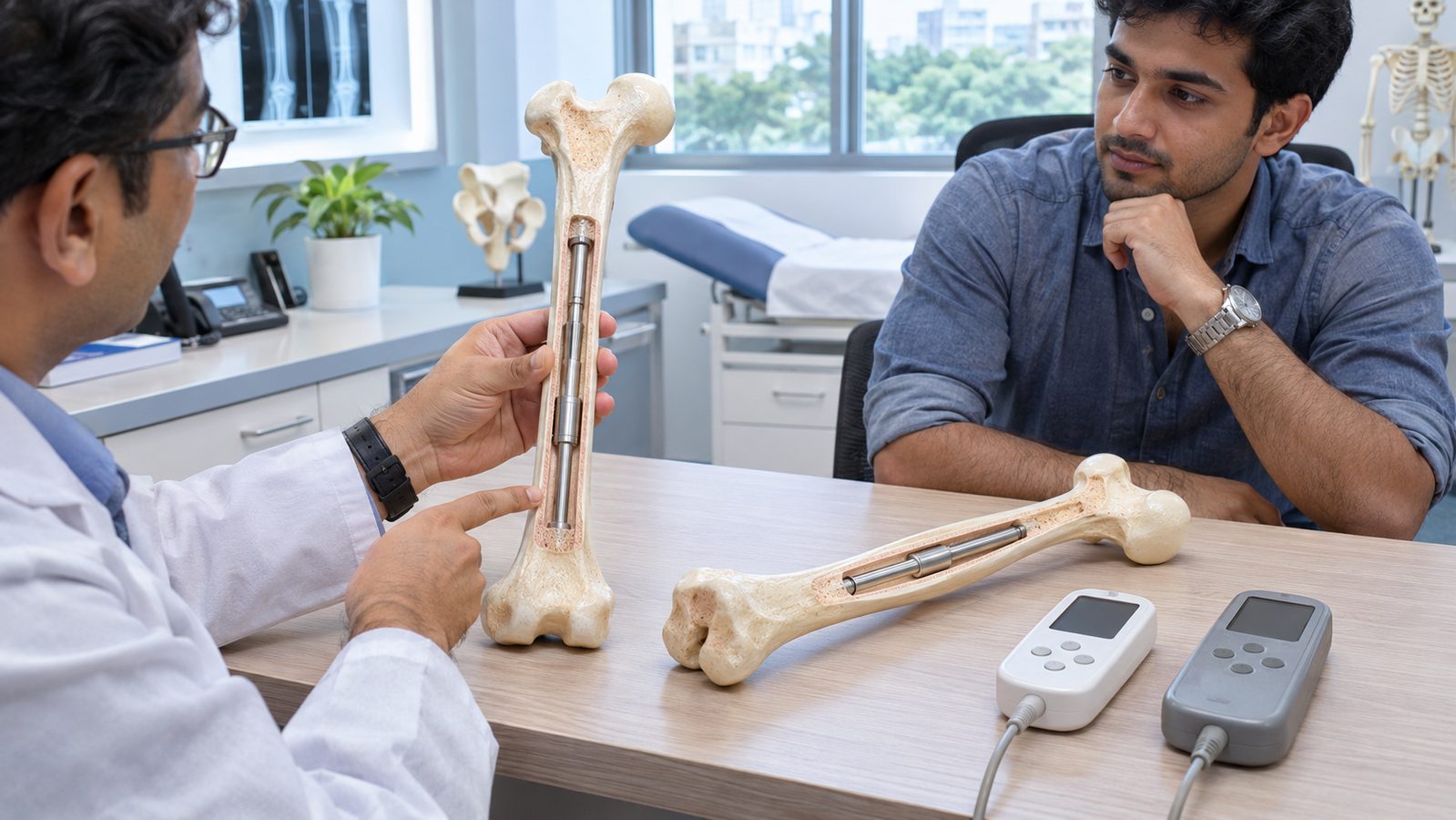
Two names often come up when patients research internal limb lengthening surgery: FITBONE and PRECICE. Both systems use a telescopic nail inside the bone to gradually separate the bone segments after a planned surgical cut. New bone forms in the gap through distraction osteogenesis.
The important question is not which brand wins on paper. It is which device is suitable for your anatomy, treatment goal and rehabilitation needs, and which system your orthopedic surgeon is experienced in using. Internal nails avoid an external frame in suitable cases, but they do not make lengthening risk-free or remove the need for careful follow-up.
How Each Nail Makes the Bone Longer
The FITBONE limb lengthening system uses an electrically driven motor within the nail. An external transmitter transfers energy through the skin to an implanted receiver, which supplies the motor. The receiver and its connection are additional parts of the implanted system.
The PRECICE nail uses a magnetic mechanism activated by an external remote controller held over the leg. It does not require the same separate subcutaneous energy receiver. Adjustments, including any reversal where appropriate for the exact device, must follow the treating surgeon's instructions. Patients should never change the prescribed settings themselves.
FITBONE vs PRECICE: A Practical Comparison
| What to compare | FITBONE | PRECICE |
|---|---|---|
| Activation | Motor powered through an external transmitter and implanted receiver. | Internal magnetic mechanism driven by an external remote controller. |
| Additional implanted components | Receiver beneath the skin and a connection to the nail. | No equivalent separate subcutaneous energy receiver. |
| Daily routine | Position the transmitter as taught and follow the prescribed schedule. | Position the controller as taught and follow the prescribed schedule. |
| Weight bearing | Restricted according to the exact implant and clinical plan. | Restricted according to the exact implant and clinical plan. |
| Recovery | Requires bone-healing checks, joint monitoring and rehabilitation. | Requires bone-healing checks, joint monitoring and rehabilitation. |
| Removal planning | Discuss removal of both the nail and receiver. | Discuss the device-specific removal timeline before surgery. |
Device families and generations are not interchangeable. Confirm the precise model, its current instructions for use and its availability in your country instead of relying on a general brand comparison.
What Daily Life Looks Like
Lengthening is often prescribed in small sessions across the day. The rate is individualized and can be changed by the surgeon according to bone formation, joint movement and symptoms. Training covers controller placement, the treatment schedule and how to record progress.
Operating the controller is only one part of recovery. Muscles and other soft tissues must adapt as the bone lengthens. A nail cannot replace exercises that maintain movement and strength. A structured rehabilitation program, regular reviews and following the agreed walking restrictions remain essential with either system.
Do not assume an internal nail allows immediate unsupported walking. Ask for written instructions on weight bearing, walking aids and the milestones needed before increasing load.
Where the Hardware Sits
Both nails sit within the bone's medullary canal. Surgical planning takes account of canal size, bone length, alignment, joint health and the available nail dimensions. With FITBONE, the receiver also needs a suitable position beneath the skin, so ask about its location, comfort and eventual removal.
Keep a record of your implant model and tell imaging staff about it before any scan. Do not assume either system is MRI-compatible. The radiology team and treating surgeon must check the exact device's current MRI safety instructions before arranging an MRI.
After Lengthening Stops: Consolidation and Bone Healing
Reaching the planned length does not mean the new bone is ready for unrestricted activity. During consolidation, the regenerate bone matures and becomes stronger. This stage can take longer than distraction, and the timeline varies between patients.
The treating team uses follow-up examinations and imaging to decide when loading can increase. Smoking, nutritional problems and other health factors can interfere with recovery; discuss these before surgery rather than relying on the implant to compensate for them. Supplements should be based on clinical advice, not self-prescribed high doses.
Neither nail guarantees a particular healing speed. Both support a controlled mechanical process while your body builds and strengthens new bone.
When the Nail Comes Out
Removal should be part of the original treatment plan, not an afterthought. Do not assume that a lengthening nail can remain indefinitely simply because it feels comfortable. The timing depends on the device's instructions, bone healing and the surgeon's assessment.
The FDA's June 2023 communication on the PRECICE IMLL system reminds clinicians that the device should be removed after one year. FITBONE guidance also calls for removal of the nail and receiver after consolidation. Discuss how these requirements apply to your specific implant and healing progress with your surgeon.
Hardware removal is another operation, with its own risks, cost and recovery period. It is not always simpler than implantation. Ask what happens if healing is delayed, whether additional procedures might be needed and what activity restrictions apply afterward.
Which Bone Is Being Lengthened?
Femoral and tibial lengthening create different demands on muscles, joints and nerves. Maintaining knee movement is an important part of femoral rehabilitation; ankle movement and nerve symptoms also need careful monitoring during tibial lengthening. Your starting anatomy matters as much as the nail brand.
New numbness, weakness, worsening pain or a noticeable loss of movement should be reported promptly to the treating team. Any pause or adjustment to distraction should be directed by the surgeon. Read our tibia versus femur lengthening guide for more on segment choice and walking recovery.
What to Ask Before Booking
- Which exact nail model is proposed, and why is it suitable for my bone dimensions and treatment goal?
- How much experience does the operating surgeon have with this system and comparable cases?
- What complications have occurred, and how are they managed?
- What are my weight-bearing limits, and which walking aids will I need?
- Who monitors bone formation, joint movement and nerve symptoms during treatment?
- What is the plan if the device stops lengthening or healing is slower than expected?
- For FITBONE, where will the receiver sit and how will it be removed?
- When is removal planned, and is it included in the quoted cost?
Availability and the Full Cost of Care
A device available in one country may not be available or approved for the same use elsewhere. Clinics may work with only one system. Ask the treating surgeon to confirm current local availability, the proposed indication and access to follow-up support.
Compare written, itemized treatment plans rather than implant prices alone. Hospital care, anesthesia, rehabilitation, accommodation, follow-up imaging, travel, removal surgery and unexpected additional treatment can all affect the total. Neither FITBONE nor PRECICE has one universal price.
Choosing Between Them
There is no single best nail for every patient. FITBONE and PRECICE differ in how they are activated and in their implanted components, but both require appropriate patient selection, skilled surgery and sustained rehabilitation. Familiarity with a device is useful, but it should not replace an explanation of why it fits your individual needs.
Ask for a second orthopedic opinion if the rationale is unclear. To discuss available methods and recovery planning, contact Height Increase Info. Final surgical decisions should be made with the operating orthopedic surgeon.
Device Guidance and Further Reading
- Orthofix: FITBONE intramedullary limb lengthening system
- Orthofix: FITBONE Control Set instructions, including removal guidance
- FDA: PRECICE device guidance, June 2023
- International Center for Limb Lengthening: PRECICE patient information
General patient information, not an individual treatment recommendation. Device instructions and availability vary by model and country. Confirm your current treatment and safety instructions with your orthopedic surgeon.