
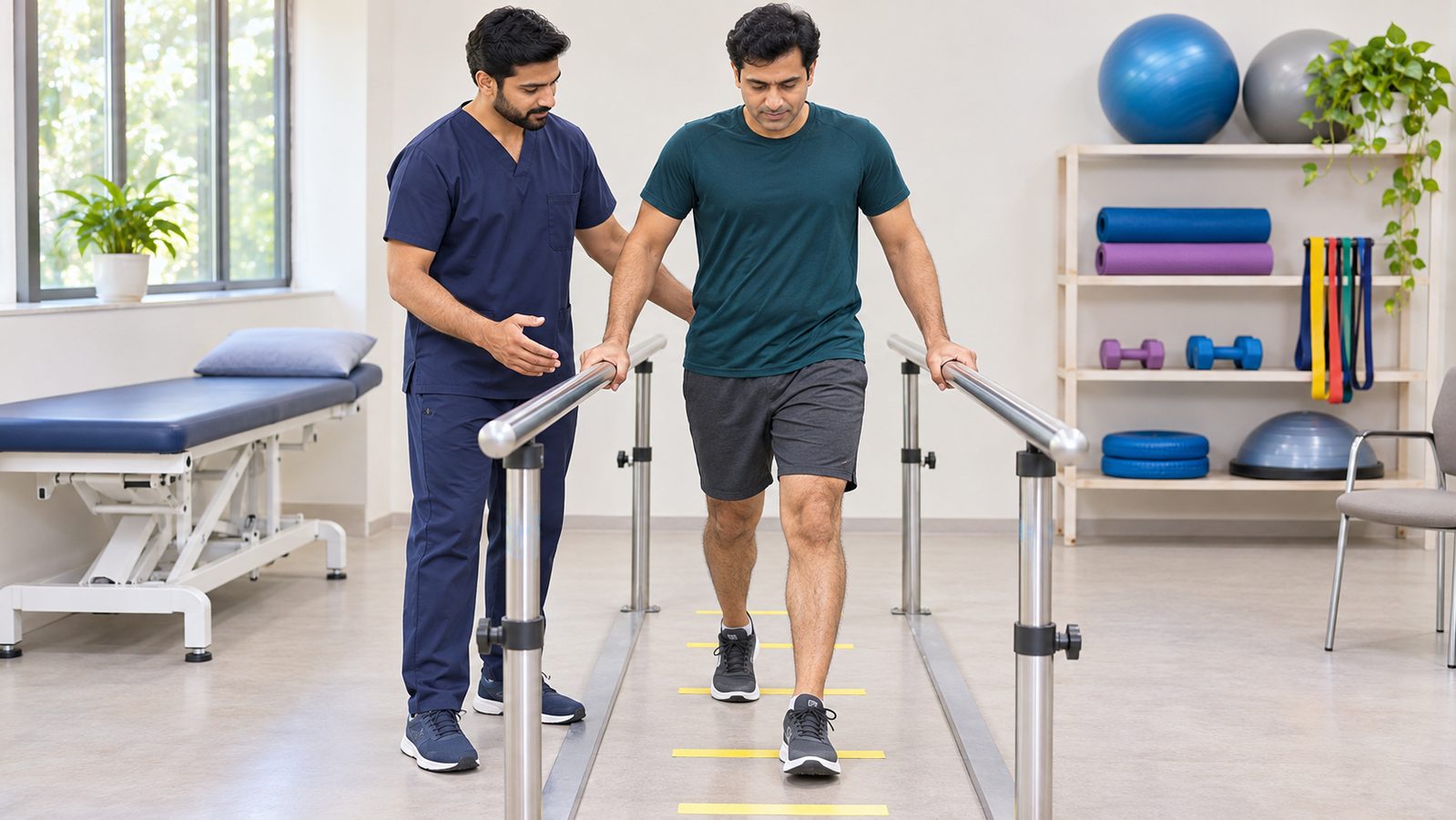
The first steps after a leg injury or surgery can feel unfamiliar. One hip may lift more than the other, a step may become shorter, or the body may lean to avoid loading a sore leg. These changes can be difficult to notice yourself, even when a physiotherapist can see them clearly.
Functional gait training is the part of rehabilitation that helps you practise walking safely and more effectively. It combines assessment, targeted exercises and repeated walking practice, with the aim of improving everyday mobility rather than simply covering a longer distance.
Why Your Walking Pattern Changes
Pain, swelling, weakness and joint stiffness can all change how you walk. You may spend less time on the affected leg, lean away from a weak hip, or swing the leg outward because the knee does not bend comfortably. These movements can be protective early in recovery, but some may persist after the original reason has improved.
Not every limp is just a habit. Healing status, alignment, nerve function and prescribed weight-bearing restrictions also matter. Gait training starts by identifying the cause instead of asking you to force a symmetrical walk before your leg is ready.
After limb lengthening treatment, muscles and joints are also adapting to a longer bone. Your surgeon and physiotherapist need to coordinate the walking plan with distraction, consolidation and the limits of the fixation device.
How a Physiotherapist Reads Your Walk
A gait assessment often begins with observation over a short, safe walking distance. The therapist watches your trunk, pelvis, hips, knees and ankles, along with step length, foot placement and how you use a walking aid. Strength, joint movement, sensation and balance may also be assessed.
Gait analysis and biomechanics help connect what is visible to the forces and movements involved. Where available and clinically useful, video, pressure-sensitive walkways or motion sensors can add measurements. Not every patient needs a specialist gait laboratory: a structured clinical assessment can still provide useful information.
For example, a shorter step may relate to pain, reduced confidence, limited hip movement or a restriction on loading. The same visible pattern can have different causes, so the exercise plan should follow the assessment rather than a generic checklist.
Understanding the Stance Phase and Swing Phase
A walking cycle has two main phases, but they are not equal halves. During the stance phase, the foot is in contact with the ground. During the swing phase, it moves forward through the air. At a comfortable walking speed, stance usually occupies more of the cycle than swing; the proportions change with speed and walking difficulty.
| Phase | What happens | What the therapist may assess |
|---|---|---|
| Stance | The foot contacts the ground and supports the body within the permitted loading limit. | Balance, pelvic control, knee stability, weight transfer and time spent on the leg. |
| Swing | The foot clears the floor and advances for the next step. | Hip and knee movement, ankle position, toe clearance and step placement. |
Lower limb kinematics describes how the hip, knee and ankle move through these phases. Looking at the whole sequence helps the therapist distinguish a stiff joint from weakness, compensation or a problem with timing.
What Functional Gait Training Sessions Involve
Much of gait training is focused practice: a short walk, feedback, a rest and another attempt. Depending on your assessment, a therapist may work on posture, step placement, controlled weight transfer, knee movement or using a walking aid correctly. A cue such as changing step length is useful only when it is appropriate for your condition and restrictions.
Parallel bars, walkers, crutches or a cane may provide support. There is no compulsory sequence that every patient follows. The safest aid depends on balance, strength, coordination, the environment and the amount of weight you are allowed to put through each leg.
As ability improves and the clinical team permits, practice may include turning, changes of pace, steps and carefully controlled obstacles. These are planned activities with supervision, not unexpected trip hazards. At home, walking routes should remain clear and safe.
Walking practice is usually supported by exercises for joint mobility, strength and balance. Our rehabilitation service explains the role of physiotherapy in recovery planning.
When More Support Is Needed
Some people recovering from neurological conditions, such as a stroke or spinal cord injury, need a different level of assistance. Depending on the diagnosis and assessment, specialist services may use body-weight-supported stepping, a prescribed brace, functional electrical stimulation or robotic assistance.
These options are not suitable for everyone and should not be assumed to be necessary, available at every clinic, or appropriate after orthopedic surgery. They require individual assessment and trained supervision. Their role is to support purposeful practice, not to replace rehabilitation or override surgical restrictions.
How Progress Is Measured
Progress can be gradual enough that it is hard to feel from one day to the next. Repeat assessments help show whether step length, joint movement, balance, walking speed or endurance is changing. The amount of support needed and the ability to manage everyday tasks also matter.
A useful review compares similar conditions: the same walking aid, a similar distance and a record of symptoms and fatigue. Video can help explain a movement pattern, while timed walking or other clinical tests may track functional change.
Persistent knee stiffness, toe dragging or an increasing limp should prompt reassessment. Earlier review can help identify a problem, but no particular week of recovery guarantees that it will be easy to correct.
Practising Safely at Home
Your physiotherapist should provide a home plan that specifies the walking aid, permitted load, amount of practice, rest periods and symptoms that mean you should stop. A fixed walking schedule or a single pain-score cutoff is not appropriate for every patient.
- Follow your surgeon's weight-bearing instructions at home as well as in the clinic.
- Use the prescribed walking aid until the treating team agrees it can change.
- Choose a clear, well-lit route and wear suitable footwear.
- Record practice time or distance, symptoms and any difficulty for your next review.
- Do not add obstacles, increase loading or practise unsupported simply because a session feels easier.
Stop and contact the treating team if walking causes new or worsening pain, instability, numbness or weakness. Sudden breathlessness or chest pain needs urgent medical assessment. Ask your team for specific instructions about swelling, wound problems and other postoperative warning signs.
Different People Have Different Timelines
A healed ankle injury, a reconstructed leg and a neurological condition are different rehabilitation problems. Bone healing, muscle strength, joint motion, balance and the underlying diagnosis all influence progress. After limb lengthening, the fact that the planned height has been reached does not mean the bone is ready for unrestricted walking.
Fear of falling or of hurting the leg can also affect how you step. A physiotherapist can help you build confidence through appropriately supported tasks and explain when a protective movement remains necessary. Removing support too early is not a shortcut to recovery.
Our guide to tibia versus femur lengthening and gait explores how the segment being treated can affect walking and rehabilitation needs.
When to Arrange a Gait Assessment
Ask for a review if you are unsure how much weight you can put through the leg, keep catching your toes, feel unsteady, or notice that your limp is worsening or not improving as expected. You do not need to wait several months if there is a concern.
Imaging and gait assessment answer different questions. A scan can help assess bone or joint structure, while observing movement shows how the limb functions during a task. One does not automatically replace the other.
Functional gait training works best when it addresses the reasons behind your walking pattern and stays within your medical restrictions. To discuss assessment and a tailored rehabilitation plan, contact Height Increase Info.
Further Reading
- Columbia Orthopaedic Group: rehabilitation and gait training
- Penn Medicine: limb lengthening recovery and rehabilitation
- Hospital for Special Surgery: limb lengthening and physical therapy resources
- NICE: stroke rehabilitation recommendations, including walking support
General educational information, not an individual exercise prescription. Follow the guidance of your treating surgeon and physiotherapist. Recovery and walking outcomes vary.