
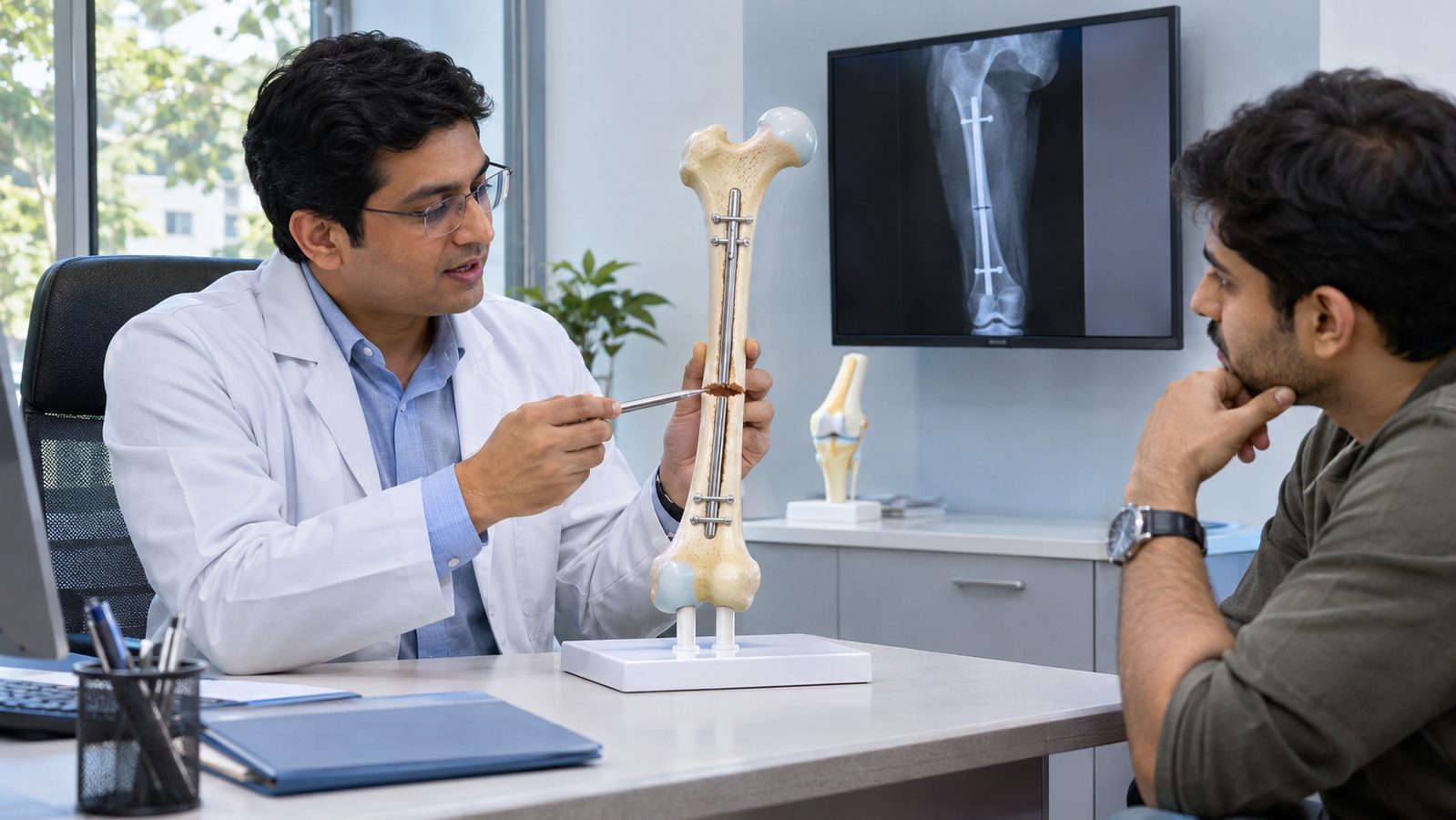
Months after a fracture, it can be worrying to hear that the bone has made little progress on follow-up X-rays. The rod or plate may still be in place, yet the broken ends have not joined securely. Persistent pain or difficulty using the limb can add to that uncertainty.
Fracture nonunion treatment starts with finding out why healing has stalled. There is no single operation that suits every case. The orthopedic surgeon needs to assess the fracture, its stability, the surrounding tissues, possible infection and the patient's general health before recommending a plan.
Slow Healing Is Not Always Nonunion
A delayed union is a fracture that is taking longer than expected to heal but may still be progressing. A nonunion is a fracture that has failed to unite and is unlikely to heal with additional time alone. The distinction is not made from one symptom or one X-ray.
Surgeons compare images taken over time and consider the type of fracture, how it was treated, examination findings and changes in symptoms. There is no single calendar threshold that applies equally to every bone and injury. A visible fracture line does not, by itself, prove that healing has stopped.
Ongoing pain with loading, a sense of movement at the fracture or recurrent swelling deserves review. Do not deliberately test the limb for movement or increase weight bearing to find out whether it has healed.
What Gets in the Way of Bone Healing?
A healing fracture needs an appropriate mechanical environment as well as living tissue capable of making new bone. A severe injury can damage the blood supply and surrounding muscle. A gap, poor alignment or inadequate stability can also prevent the broken ends from bridging successfully.
Other delayed bone healing causes and risk factors include smoking, diabetes, nutritional deficiencies and certain medical conditions or medicines. These factors do not mean that every affected patient will develop a nonunion, but they help guide the assessment. Do not stop prescribed medication without speaking to the clinician who manages it.
Sometimes several problems are present at once. Strengthening the fixation alone may not be enough if there is also infection, a bone defect or compromised soft tissue.
Why Surgeons Check for Infection
Infection around a fracture or implant can interfere with healing, even without obvious fever or redness. A wound that drains, breaks down or repeatedly becomes inflamed is important to report, but the absence of these signs does not rule infection out.
Blood tests can contribute to the assessment, but they cannot reliably confirm or exclude every fracture-related infection. When surgery is needed, appropriately collected deep tissue samples can help identify an organism and guide antibiotics. The surgeon interprets these results alongside the examination and imaging.
Infected nonunion needs a coordinated plan that addresses infection and fracture stability. Depending on the case, reconstruction may be performed in one operation or in planned stages. Antibiotic selection and timing should be managed by the treating team, not self-directed.
Hypertrophic and Atrophic Nonunion
Surgeons may describe the appearance of a nonunion as hypertrophic or atrophic. These terms help explain the healing pattern, but they do not replace a full assessment.
| Pattern | Typical appearance | What the team considers |
|---|---|---|
| Hypertrophic | Substantial callus forms, but it has not bridged the fracture securely. | Whether instability, alignment or another mechanical issue is preventing union. |
| Atrophic | There is little visible callus or healing activity at the fracture ends. | Bone viability, local biology, bone loss, infection and the need for biological support as well as stability. |
The X-ray appearance alone cannot establish the blood supply or rule out infection. A treatment plan may need to address both mechanical and biological factors, whatever label is used.
What Can Be Done Before Further Surgery?
The first step may include improving the conditions for healing: support to stop smoking, assessment of nutrition, management of diabetes and correction of a confirmed deficiency where appropriate. Supplements are not a substitute for a balanced diet or treatment of the underlying problem.
Selected cases may be managed with continued protection or immobilization, and a clinician may consider a bone stimulator. Ultrasound and electrical or electromagnetic stimulation are options used in some settings, but suitability and evidence vary. A device should not delay necessary treatment for significant instability, infection or implant failure.
Ask what improvement is expected, how it will be measured and when the plan will be reviewed. Nonsurgical care is an active treatment decision, not simply waiting without follow-up.
How Surgery Treats a Nonunion
Surgery is planned around the reasons the fracture has not healed. The surgeon may improve fixation, restore alignment, treat a bone defect or add bone graft. A graft may come from the patient's own bone or another suitable source, depending on the reconstruction. Grafting does not replace the need for adequate stability.
Revision fixation can involve a plate, a nail, an external frame or a combination. Where tissue is infected or no longer viable, surgical cleaning and appropriate soft-tissue care may be required. Complex cases can need input from infection specialists or plastic surgeons as well as the orthopedic team.
Our nonunion fracture treatment page outlines the role of specialist assessment and reconstruction planning.
What Is Exchange Intramedullary Nailing?
Exchange intramedullary nailing is one option for selected long-bone nonunions when a nail is already present. The existing nail is removed, the canal may be reamed, and a new nail is inserted. A larger or differently configured nail can improve the mechanical support when appropriate for the bone and fracture pattern.
Reaming can also contribute biological material at the fracture region, but this does not guarantee healing or eliminate the need for a separate graft. Some procedures require additional fixation or direct work at the nonunion site.
Exchange nailing is not suitable for every case. Fracture location, alignment, bone loss, implant condition and infection all affect the choice. An infected nonunion requires an infection-specific strategy rather than a routine nail exchange; nail revision may still be part of a specialist reconstruction plan.
Nonunion Femur Fracture Treatment
The femur carries substantial loads during daily activity, so a thigh-bone fracture that has not united can have a major effect on mobility. Assessment includes the original injury, previous operations, the location of the nonunion, alignment and the condition of the existing implant.
Depending on those findings, options may include exchange nailing, plate fixation or augmentation, grafting, or a combination. A nonunion near a joint may require a different approach from one in the middle of the shaft. The choice should be explained in relation to your own scans, not just the name of the operation.
Recovery After Nonunion Treatment
Recovery often takes months, but the timeline varies with the fracture and the reconstruction. Follow-up examinations and imaging help the surgeon judge progress. Walking aids and weight-bearing restrictions are prescribed individually; they should not be changed based on pain alone.
A coordinated rehabilitation program helps maintain or restore movement, strength and function within those limits. When walking is permitted, gait training during rehabilitation can help address compensatory patterns and confidence.
If healing remains slow, the team should reassess the reasons rather than assume that repeating the same intervention will solve the problem. No technique can promise union in every patient.
When to Seek an Orthopedic Review
Arrange a review if pain persists beyond the expected course, function is not improving, or you feel instability around a previous fracture. Bring earlier X-rays, operation records and details of any infection treatment so the specialist can compare progress.
Seek urgent medical assessment for new deformity, sudden loss of ability to use the limb, a cold or numb foot or hand, or worsening wound symptoms with fever or feeling unwell. Do not wait for a routine appointment if symptoms change suddenly.
Effective fracture nonunion treatment begins with understanding the cause. To discuss an assessment and available support, contact Height Increase Info. Surgical recommendations must come from the treating orthopedic surgeon after reviewing your case.
Further Reading
- American Academy of Orthopaedic Surgeons: nonunions
- Hospital for Special Surgery: nonunion fracture diagnosis and treatment
- AO Surgery Reference: infection and nonunion treatment approaches
General educational information, not a diagnosis or individual treatment recommendation. Treatment, weight bearing and recovery depend on your clinical assessment.