
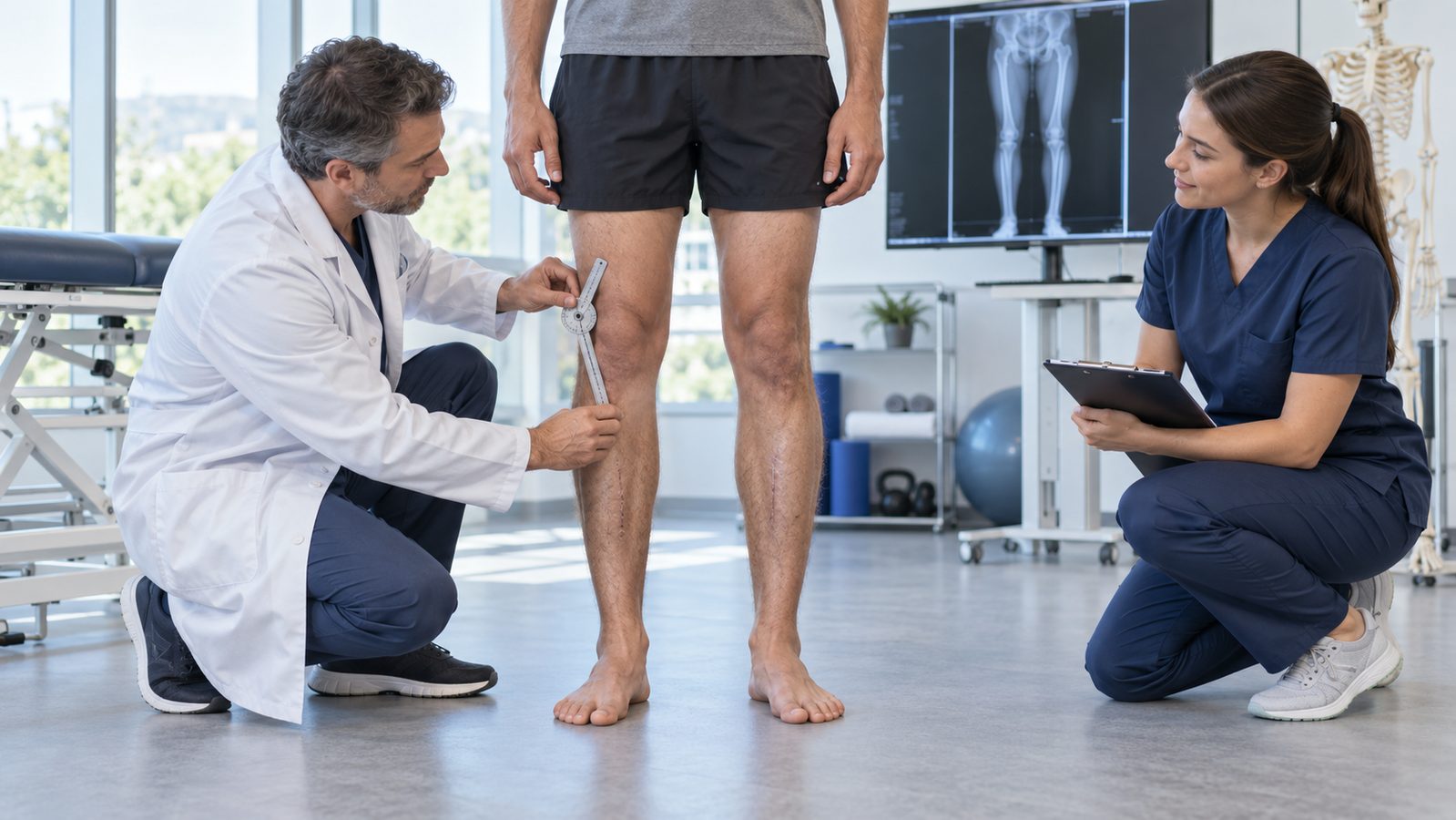
Most people begin researching limb lengthening by thinking about centimeters, recovery time, and final height. Later, a more visual question often appears: will the knees or the overall shape of the legs look different after surgery?
It is a reasonable concern. Knee appearance after limb lengthening surgery can look different during recovery because of swelling, reduced muscle bulk, scars, and the new proportion between the joint and the longer bone. Those changes do not all mean the knee joint itself has been reshaped.
The Knee Joint Is Not Normally Reshaped
Standard femoral or tibial lengthening is performed through a controlled bone cut away from the articular surface of the knee. The goal is to create new bone within the femur or tibia, not to reconstruct the cartilage, ligaments, or kneecap.
What patients notice visually is more often a change in the surrounding tissues or in the proportions of the limb. If a treatment plan also includes angular or rotational deformity correction, however, the mechanical alignment and silhouette may change more noticeably by design.
Proportion Changes More Than the Knee Itself
Lengthening the femur or tibia changes the ratio between the knee, thigh, calf, and foot. The knee may appear slightly smaller relative to a longer leg even though the joint has not physically become smaller.
The segment selected and the amount of length gained influence the final silhouette. Our guide to tibia versus femur lengthening explains how each segment can affect gait and lower-limb proportions differently.
Temporary and Longer-Term Appearance Changes
| Change | What patients may notice | Typical course |
|---|---|---|
| Swelling | Puffiness can make the knee contour look wider or less defined. | Usually improves as healing progresses and activity normalizes. |
| Muscle loss | Reduced thigh or calf bulk can make the knee look more prominent. | Often improves gradually with nutrition, rehabilitation, and restored activity. |
| Scars | Incisions or pin sites may remain visible near the thigh, shin, or knee region. | Scars generally mature and fade over time but do not disappear completely. |
| Leg proportions | The knee, foot, thigh, and calf may look different relative to the longer segment. | The proportion change is lasting, while visual familiarity and muscle contour continue to evolve. |
| Alignment | The leg silhouette may change if deformity correction is part of the plan. | Planned alignment correction is permanent and should be discussed before surgery. |
Muscle Changes Around the Knee Are Common During Recovery
Reduced activity and temporary weight-bearing limits can decrease quadriceps and calf muscle bulk. The outline of the kneecap may look sharper because there is less surrounding muscle rather than because the joint has changed shape.
Muscle strength and joint motion are important functional outcomes after lengthening. A structured limb lengthening rehabilitation program focuses on knee range of motion, flexibility, strength, balance, and gait throughout distraction and consolidation.
Scars and Incision Placement Should Be Discussed Early
Scar location depends on the selected technique, implant, entry point, and whether an external fixation system is used. Internal nailing involves surgical incisions, while external methods can also leave multiple pin-site marks.
Scars normally change in color and texture as they mature, but their final visibility varies with skin type, wound healing, genetics, sun exposure, and scar care. Patients concerned about appearance should ask the surgeon to show where incisions or pin sites are expected before choosing a method.
Swelling Is Not the Final Result
Swelling around the knee can make the joint look puffy during active treatment. Early recovery photographs should not be treated as a preview of the settled result because soft tissue, muscle contour, and activity levels are still changing.
New, increasing, one-sided, painful, hot, or persistent swelling should be assessed by the clinical team. Appearance concerns must not distract from symptoms that may need medical review.
Kneecap Tracking and Alignment Require Monitoring
Gradual lengthening places stress on muscles and other soft tissues that cross adjacent joints. Maintaining knee motion and muscle balance is therefore central to treatment. Patients with previous knee instability, congenital differences, or combined deformity correction may require particularly close monitoring.
Painful clicking, a sense of instability, loss of motion, or an obvious change in alignment should not be dismissed as cosmetic. These findings need evaluation by the treating surgeon and rehabilitation team.
The Whole Lower-Limb Silhouette Changes Together
Limb proportions after lengthening surgery are seen as one connected picture. A longer femur changes how the thigh relates to the knee. A longer tibia changes the visual relationship between the knee, calf, ankle, and foot. Even an unchanged foot can appear smaller beside a longer leg.
Final planning should consider realistic length goals, segment selection, starting anatomy, and overall body proportions. These points form part of a detailed limb lengthening surgery evaluation, not an afterthought once lengthening has begun.
Questions to Ask Before Surgery
- Where will the incisions or pin sites be placed?
- How might femoral versus tibial lengthening affect my proportions?
- Is any angular or rotational correction included in my plan?
- How will knee motion, alignment, and muscle strength be monitored?
- What scar-care guidance is appropriate for my skin and procedure?
- Can I review comparable patient photographs at later recovery stages?
Frequently Asked Questions
Will my kneecaps become smaller after limb lengthening?
The kneecaps do not normally become smaller. They may look smaller relative to longer femur or tibia segments, and temporary muscle loss can change how prominently they appear.
Does knee swelling go away after lengthening?
Recovery-stage swelling often improves as healing progresses, but the timeline varies. Persistent, painful, hot, or increasing swelling should be reviewed by the treating team.
Are scars around the knee permanent?
Surgical and pin-site scars can fade and flatten with time, but they do not disappear completely. Their location and final visibility depend on the method, healing, and individual skin response.
The Bottom Line
In a standard case, limb lengthening changes bone length rather than rebuilding the knee joint. The early visual differences patients notice are often driven by swelling, muscle loss, scars, and changing proportions. Some improve with recovery, while scars and the new limb proportions remain to varying degrees.
A realistic preoperative conversation should cover both function and appearance. To discuss segment choice, expected scars, alignment, rehabilitation, and proportions with the clinical team, schedule a consultation with Height Increase Info.